






Welcome To Shawpak Systems Ltd
Established in 1984 Shawpak Systems prides itself on providing high level technical sales and support to our valued customer base. Offering solutions for Product Inspection, Packaging and Hygiene equipment sales and after sales support including certified customer training on site or at our Centre of Excellence training and demonstration facility.
What Our Clients Are Saying
North American Distributor Hygiene Equipment Solutions
Shawpak are the exclusive distributor in North America for Hygiene Solutions with complete parts and service support.
Product Safety
Our experience in the product inspection industry is essential to the success of our quality assurance program, because we can enhance the safety of your products by detecting contaminants, for the removal, before those products reach your consumers.
Protection and Trust
Protecting your customers, shareholders and brand is your ultimate goal. Ensuring that you have the proper equipment to do the job is ours.
Technical Advisors
Shawpak Systems Technical Advisors will guide you through the best practice options available based on your specific application, acting as your Trusted Advisor.

Frontamtic Hygiene
Frontamtic Hygiene is a comprehensive approach to controlling contamination at entry and exit points in food processing, manufacturing, and pharmaceutical facilities, using automated boot cleaning systems, hand sanitization stations, and hygiene checkpoints integrated into facility workflows.
At Shawpak Systems Ltd in Oakville, Ontario, we have spent nearly four decades helping manufacturing and food processing plants across North America protect their operations through intelligent hygiene infrastructure. The stakes in these industries are high: a single contamination event can compromise product integrity, trigger regulatory action, damage reputation, and halt production. Frontamtic Hygiene addresses this problem by making hygiene enforcement automatic rather than reliant on human compliance alone.
This guide explains how these systems work, why they matter for your facility, and how to choose the right approach for your operation.
What Frontamtic Hygiene Systems Actually Do
Think of an industrial boot cleaner as a security checkpoint for your production floor. Just as a border crossing stops vehicles to inspect them, an automated boot cleaning station stops workers and removes soil, bacteria, and chemical residue before they enter controlled areas. The difference is speed and consistency: a worker walks into the machine, brushes rotate and dry the boots in seconds, and they move forward. No step is skipped. No one forgets.
These systems are the physical cornerstone of what we call Frontamtic Hygiene. They sit at the boundary between the outside world and your clean zone. But they work alongside other equipment: hand sanitization systems at critical points, Crate cleaning automation for incoming materials, and sometimes turnstile access controls that log who entered the hygiene zone and when. Together, they form a layered defense.
For food processing facilities, meat processing operations, and pharmaceutical companies, this layering is not optional. Regulatory frameworks expect documented proof that contamination pathways have been interrupted. An automated system provides that proof: every cycle is logged, every worker passes through, every shift is accounted for.
Facilities that deploy Industrial boot cleaners and integrated hand sanitization typically reduce microbial contamination events by 60 to 80 percent in their first year of operation, because the systems make compliance automatic rather than aspirational.
Why Oakville and North American Facilities Choose This Approach
Oakville sits at the crossroads of Ontario's industrial belt. The region is home to precision manufacturing, food processing operations, and distribution centers that serve the entire continent. These are not small operations: they run multiple shifts, employ hundreds, and ship products across borders. Contamination costs them money instantly and reputation permanently.
Before automated hygiene systems became standard, facility managers relied on signage, training, and spot checks. All three have a human failure rate. A worker in a hurry, a trainer who moves on, a supervisor who checks in the wrong zone at the wrong time. Shawpak Systems understood that education matters, but enforcement through equipment matters more.
We work with plant managers and operations directors across Oakville and across North America because they recognize that hygiene is not a cost center to minimize; it is a production control that pays for itself through reduced downtime, fewer recalls, and faster regulatory approvals. An industrial boot cleaner costs less per day to operate than the cost of a single production halt caused by contamination.
Pharmaceutical companies in particular have adopted these systems rapidly. Regulatory audits now expect them. Food processing plants competing for contracts with major retailers use them as a compliance proof point. Manufacturing plants serving automotive and medical device sectors recognize that particle control begins at the entry door.
Key Components and How They Integrate
A complete Frontamtic Hygiene installation typically includes four elements, though not every facility needs all four.
Industrial boot cleaners form the core. These are the entry-point machines. Workers step in, brushes rotate to remove dried soil, air jets dry the boots, and they exit. Modern units cycle in 20 to 40 seconds depending on contamination level. They are built for high-volume use and require minimal maintenance when installed correctly.
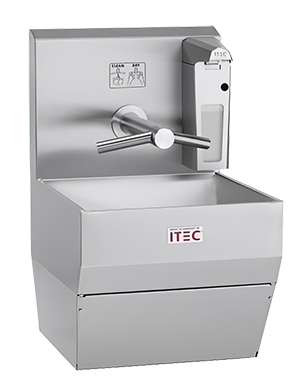
Hand sanitization systems sit downstream, often at the entrance to the production zone itself. Some are automatic dispensers; others are hygiene stations with soap, sanitizer, and drying. The principle is the same: make compliance frictionless. If a worker has to walk 50 feet to find sanitizer, compliance drops. If the station is two steps away, compliance approaches 100 percent.
Crate cleaning automation addresses incoming materials. Vegetables, meat, packaging, and other inputs arrive on crates or pallets that carry soil and microbes. Automated cleaning systems rinse and sanitize these containers before they enter the production area. This stops contamination at the source, not just at the worker level.
Access control and logging complete the picture. Some facilities add card reader turnstile systems that track which employees passed through hygiene stations and when. This provides the documentation that auditors expect and helps identify patterns if a contamination event occurs.
Shawpak Systems designs these configurations during an advisory consultation with your operations team. We do not install the same system everywhere. A small specialty food producer in Oakville has different needs than a large meat processing facility serving three provinces. We match the system to the facility's risk profile, throughput, and regulatory environment.
Technical Expertise and Training Make the Difference
Buying equipment is not the same as implementing a hygiene system. This is where Shawpak Systems separates itself from equipment-only suppliers.
When we work with a facility, we conduct an on-site audit to identify contamination pathways specific to that plant. We review workflows, understand pinch points, and recommend equipment placement and sequencing. We then provide on-site training for your maintenance staff and operators so they understand how the system works, how to respond if a machine stops, and how to keep it running reliably.
Our Centre of Excellence demonstration facility in Oakville allows managers and supervisors to see and test equipment before committing to it. You can run actual product through a shrink wrapping system, see how a boot cleaner handles different types of contamination, and discuss configuration options with our technical advisors face to face.
After installation, our parts distribution network and certified after-sales support mean you are not left to troubleshoot alone. If a sanitizer station fails during a shift, you call us. We carry parts across Canada and the USA, and our support team knows these systems inside out because we have installed hundreds of them.
Practical Recommendations for Your Facility
If you operate a food processing plant, manufacturing facility, or pharmaceutical operation, here is how to move forward.
First, conduct a baseline audit. Map where contamination enters your facility. Is it through personnel boots? Through incoming materials? Through air handling systems? Frontamtic Hygiene systems address personnel and material pathways effectively. If your primary risk is airborne or environmental, the system is only part of the answer.
Second, talk to your regulatory contacts. If you are seeking approval for a new product line or facing pressure from an auditor, ask them which contamination controls they expect to see. This conversation focuses your investment on what matters most for your compliance posture.
Third, involve your operations team early. The best-designed system fails if workers resent it or if maintenance staff do not understand it. Buy-in from plant managers, operations directors, and facility supervisors is not just nice to have; it is essential to success.
Fourth, plan for scale. If you currently operate in Oakville and plan to expand regionally, design your system so it can be replicated at new locations. Shawpak Systems can help you document the configuration so future facilities are consistent and your staff can support them.
If you are ready to explore how industrial boot cleaners, hand sanitization systems, and integrated hygiene infrastructure can protect your operation, reach out to the team at Shawpak Systems Ltd. We serve food processing, pharmaceutical, manufacturing, and meat processing facilities across North America. We can arrange a consultation, discuss your specific contamination challenges, and show you how other facilities like yours have solved this problem.
Frequently Asked Questions
How long does it take to install an industrial boot cleaner in Oakville?
Installation typically takes one to three days depending on facility size, electrical requirements, and water supply setup. Shawpak Systems handles site assessment, installation, and staff training as part of the implementation. Exact timing is confirmed during the on-site consultation.
Can Frontamtic Hygiene systems work in a facility that operates 24/7?
Yes. Industrial boot cleaners and hand sanitization systems are designed for continuous operation across multiple shifts. Shawpak Systems provides after-sales support and parts distribution so machines can be serviced or replaced without disrupting production, and we train maintenance teams to handle routine upkeep.
Do these systems integrate with existing access control in our facility?
Card reader turnstile systems can be configured to work alongside existing security infrastructure. During the advisory phase, Shawpak Systems reviews your current setup and recommends integration points that match your facility's control procedures and logging needs.
What is the difference between a boot cleaner and a boot drying rack?
An industrial boot cleaner uses rotating brushes and air jets to actively remove and dry contamination in seconds. A boot drying rack is a passive stand where boots air dry. For high-volume food processing and manufacturing, active cleaning provides faster cycle times and more reliable contamination removal.
How does Shawpak Systems ensure the equipment stays reliable after installation?
We provide certified after-sales support, maintain parts inventory across Canada and the USA, and train your maintenance team on routine care and troubleshooting. Our Centre of Excellence facility in Oakville is also available for retraining and consultation as your facility evolves.

Products to Suit Your Needs
- Hygiene Equipment
- Product Inspection
- Packaging Equipment
- Training and Demo Facility
- Sealing Equipment
- Custom Conveyors
- Consultant Service
- Direct Drive Technology
- Spare Parts
- Test Samples
Contact US
For general information or to set up an appointment please complete the form below or give us a call.
GENERAL INQUIRIES
Sales (905) 847 0122 EXT 1
Accounting (905) 847 0122 EXT 4